
Bed Bug Treatment
Bed Bug Bites: What They Look Like and How They Differ From Mosquitoes
The bottom line
A bed bug bite arrives in a straight line or a cluster of 3 to 5 welts on skin left uncovered during sleep, red and swollen with a darker dot at the center, and it stays itchy for 3 to 7 days. A mosquito bite is single, scattered, and gone within a day, and that arrangement is the fastest diagnostic difference between the two.
You wake with three red dots in a line on your arm. You search online, find a terrifying bed bug photo beside an identical-looking mosquito bite, and spend two days unsure. We take that call every week.
The skin will not settle it. Human skin answers dozens of causes the same way: a red welt and an itch. Two things separate them: how the bites are arranged, and what is on the mattress seam.
This article follows that order.
One disclaimer. This does not replace a doctor if a bite gets infected, or treatment if the infestation is past a single bed. It will keep you from spending money on the wrong thing.
What does a bed bug bite look like?
A bed bug bite is a small red welt, 2 to 5 millimeters across, with a darker dot at its center, arriving in a straight line or a cluster of 3 to 5 bites on skin that was uncovered. The arrangement is the sign, not the shape, because a red welt can come from ten other things.
What a single bite looks like
A round swelling with no sharp edge, its color fading into the skin around it, and a darker dot where the mouthpart went in. Light red on day one, darker on day two. Size varies with the skin, not the bug: a pen-tip point on one person and a ring-stone welt on the next. Skin that reacts strongly can raise a small blister of clear fluid.
The arrangement is the evidence, not the shape
A single bite tells you nothing. Three or four in a rough line, or a cluster the size of your palm, tells you a great deal. The bug bites, gets disturbed when the sleeper shifts, moves a centimeter, and bites again, so three attempts by one insect leave three marks. People read that as three insects, but the number of bites is not a count of the bugs.
Where they land on the body
Arms, neck, shoulders, face, upper back, and the legs if you sleep uncovered. The map follows what was exposed while you slept, not what was closest to the wall. And the part most people miss: bed bugs bite what is uncovered and avoid what is under fabric. They do not chew through cloth. Bites on covered skin make them less likely without ruling them out.
How long the bite and the itch last
The itch peaks on the second day, not the first, and the bite stays visible for 3 to 7 days in most people. Someone who reacts strongly carries it ten days and keeps a light brown mark for weeks. With repeated exposure the skin responds faster, so week four’s bites can look worse than week one’s with the same insects in the room. If it feels like the bugs have multiplied, that is not evidence. Your skin is answering faster.
From the field: What most often makes people rule bed bugs out wrongly is one person in the bed covered in bites and the other with none. A large share of people have no skin reaction and go months without knowing. One person bitten and nobody else points at bed bugs, not away from them.
How do I tell a bed bug bite from a mosquito, a flea, or an allergic reaction?
The difference is not the shape of the bite but how the bites are distributed, when they appear, and what turns up in the room. Bed bugs leave a line. Mosquitoes leave scattered dots.
| Criterion | Bed bugs | Mosquitoes | Fleas | Allergy or eczema |
|---|---|---|---|---|
| Arrangement | A line or a cluster of 3 to 5 | Single and scattered | Small tight groups | Patches with no fixed shape |
| Body location | Uncovered skin: arms, neck, shoulders | Any exposed part | Below the knee and around the ankles | Skin folds: elbow crease, behind the knee |
| Timing | Noticed in the morning after sleep | Felt as it happens | Any hour, usually alongside an animal | Unrelated to sleep |
| Duration | 3 to 7 days | A day or two | A few days, with sharper itching | As long as the trigger is present |
| Evidence in the room | Black dots on the mattress seam | Standing water and a whine | A pet that has been scratching | No trace anywhere in the room |
Mosquitoes
A mosquito bite appears while you are awake and you feel it happening. It swells within minutes and settles within a day or two. The bites scatter with no order. The whine is an easy supporting sign: wake to bites with no memory of buzzing and the odds tilt toward bed bugs.
Fleas
A flea jumps off the floor and does not clear 20 centimeters, so its bites gather below the knee and around the ankles, and the itch is sharper than a bed bug’s. If a cat or dog has been scratching, move fleas up the list. The mistake we hear constantly is “no mosquitoes, so it must be bed bugs.” It could be fleas from a street cat, or ticks, which lay eggs between floor tile and wall.
Allergies and eczema
These show up in the skin folds: inside the elbow, behind the knee, around the neck. The shape is irregular and there is no dot at the center. The skin around it is dry or flaking. It has nothing to do with sleep, and follows a trigger like a new detergent.
The rule that settles the argument
A bite on its own does not diagnose anything. The real evidence is in the mattress. Find black dots on the seam and the welt stops mattering. Find nothing after a serious inspection and it is probably something else.
Why do bed bug bites appear in the morning and not at night?
Because bed bugs move in the last hours of the night, and the bite is not felt at the time: their saliva carries a local anesthetic. The itch surfaces hours later, once you are up and looking at a red line on your arm.
The hour bed bugs are active
They come out roughly two hours before dawn, once the sleeper’s breathing has settled and movement dropped off. The insect reads carbon dioxide and body heat, not a clock, and both are steadiest then.
Why you do not feel the bite
Bed bug saliva carries one compound that numbs the spot and another that stops the blood clotting, so it flows until the insect is full. The meal takes 3 to 10 minutes. Your immune system then recognizes the protein, and that response is the itch.
The delayed reaction wrecks the diagnosis
The response takes a few hours to two days, longer with a first exposure, so where the bite is does not tell you where the insect is. You could be bitten in a hotel and see it appear at home a day later. Sitting up all night to catch one is wasted effort: somebody awake, switching a lamp on every quarter hour, is no target. Inspect in daylight instead.
From the field: One client stayed awake three nights with a flashlight to catch a bed bug in the act. He saw nothing, so he decided it was not bed bugs and stopped looking. He called back a month later, once the infestation had reached the living room sofa.
What are the signs of bed bugs in the room?
There are 5 signs that appear before you ever see the insect, and the most reliable is the black dots on the mattress seam, not the blood spots on the sheet. Below they run from most obvious to most reliable.
Small blood spots on the sheet
Small red or brown stains, usually noticed in the morning, most from a bite rubbed during sleep or a bug crushed under your body. The most obvious sign and the least reliable at once. A prompt to inspect, not proof.
Black dots on the seam
Tiny dots the size of a ballpoint tip, gathered along the piped edge of the mattress and in the corners of the frame. That is bed bug feces, the most reliable sign there is. Bed bugs defecate where they hide, so a concentration of dots tells you exactly where they sit.
Small translucent shells
A nymph molts 5 times before adulthood, and each molt leaves a shell the color of light honey, shaped like the insect. Find those in the corners of the bed and a full life cycle is running, so the infestation is not new.
White eggs glued in place
Tiny white grains, around a millimeter each, glued into the seam and cracks. Hard to see without a strong light and harder to wipe away, because they are stuck fast. The egg hatches after 7 to 10 days, and this is where home attempts fail.
A heavy sweet smell
An odd smell, a heavy sweetness closest to old coriander. A late sign that shows up only in a large infestation. If you can smell it walking in, it is no longer confined to the bed.
An inspection that takes 5 minutes
You need a phone flashlight and an old plastic card. Strip the sheet, take hold of the piped edge on the side of the mattress, and run the card inside the seam with the light held low. The angle throws a shadow and makes the dots visible. Do all four sides, then the face of the frame meeting the wall, then the upholstery tacks of any armchair.
From the field: A test settles a black dot in two seconds. Wet a white tissue and wipe it. If it dissolves into a reddish brown rust color, that is bed bug feces, because it is digested blood. If it stays dry, it is dust. We run this in front of the client.
Where exactly do bed bugs hide?
Bed bugs hide in the mattress seam itself, not underneath the mattress, in the wooden bed frame, and in any crack less than a meter and a half from where you sleep. They stay near the food source, so an organized inspection starts at the bed and works outward in rings.
The mattress seam and the piped edge
The number one location by a wide margin. That piped edge is a narrow dark tunnel at the temperature of the body above it, so check sewn bands and sunken buttons one at a time. It is why our first step is thermal steam on the mattress seam before any spraying: heat travels inside the edge, while a surface spray sits on the fabric and the egg survives.
The wooden bed frame
The headboard, the joints between slats, and the points where screws enter the wood. Wood absorbs moisture and opens fine cracks. If the headboard sits flat against the wall, pull it off and inspect the face that meets it, the surface most often forgotten.
Upholstered chairs and sofas
Under the bottom dust cover, in the upholstery tacks, and in the joints of fixed cushions. A living room sofa gets infested once somebody starts sleeping on it. As long as nobody does, it stays clean much longer than the bed.
Behind the outlet and the light switch plate
The void behind the plate stays warm and dark, and nobody has opened it in years. In moderate infestations we find bed bugs behind the switch plate next to the bed, not any other switch. Distance from where you sleep decides it.
Behind picture frames, the nightstand, and loose wallpaper
Anything hanging on the wall above or beside the bed, and any wallpaper lifted at its edge. Pull the nightstand drawer right out and check the back panel and the void behind it, where the joinery cracks run warmer and tighter.
The suitcase
The first place that should be inspected and the last anyone looks. A suitcase back from a hotel or student housing is the fastest route bed bugs have into a home, and it then sits in a closet unopened.
Why inspecting “under the mattress” gives you a false negative
Because the underside is open and flat, and bed bugs want a crack that presses from above and below at once. In a large infestation they also reach wall cracks and the conduits between apartments, which makes a neighbor’s unit a real factor. And the limit, up front: if the mattress is eaten through and the foam showing, nothing brings it back. We say so before we start.
From the field: We inspect by the meter-and-a-half rule: draw a circle of that radius from where the head rests and check everything inside it piece by piece, down to the book on the floor beside the bed. If the infestation is early, everything is inside that circle.
Are there insects that look like bed bugs? How do you tell them apart?
There are 4 insects that get confused with bed bugs in Egyptian homes, most often the cockroach nymph and the carpet beetle. Three do not bite people at all, which saves you an entire treatment if you can tell them apart.
| Insect | How it looks different | Where you find it | Does it bite? |
|---|---|---|---|
| Cockroach nymph | Longer and narrower, with two long antennae | Kitchen and bathroom, not the bed | No |
| Carpet beetle | Oval with a patterned, domed back | Carpets, closets, anything wool | Skin irritation from its hairs |
| Booklouse | Very small and near translucent | Paper, damp spots, old books | No |
| Engorged tick | Round and swollen, 8 legs | On the animal and in floor tile cracks | Mostly on the animal |
The marks that identify a bed bug
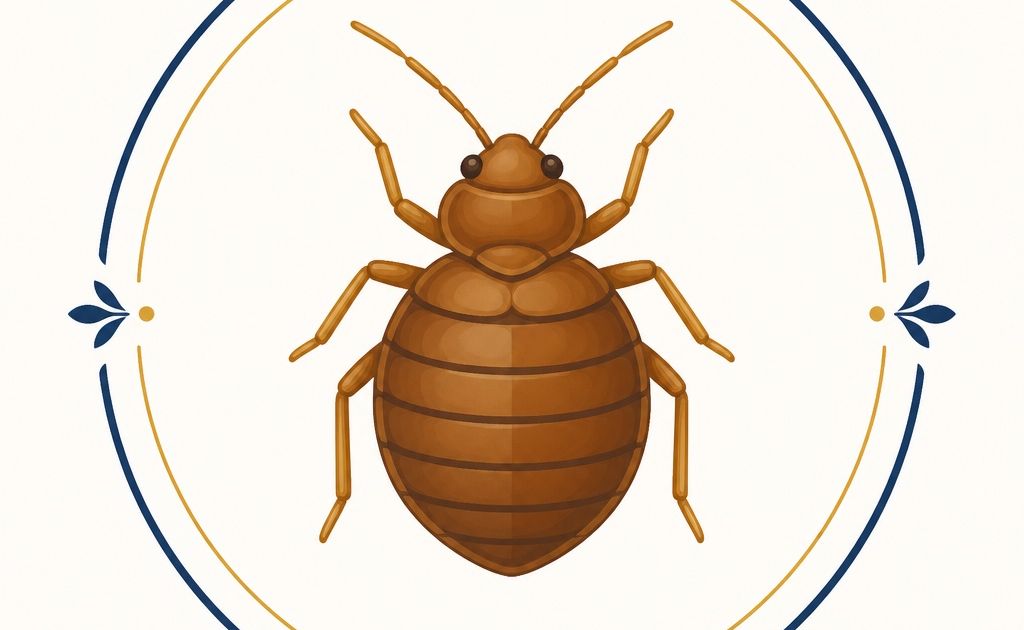
Oval and flattened like an apple seed when hungry, reddish brown, 4 to 5 millimeters long. After feeding it swells and lengthens, and the color goes toward deep red. Nymphs are smaller and lighter, near translucent before their first meal. One detail settles it: bed bugs neither fly nor jump. Anything that took off or leapt is not a bed bug.
The cockroach nymph
The one most often mistaken for a bed bug. Small and brown and quick, but longer and narrower, with two long antennae. The useful difference is location: it lives in the kitchen and bathroom near water and food, not in a mattress seam.
The carpet beetle
Oval like a bed bug, but with a domed back and a pattern of light and dark markings. It does not bite, but its larvae carry fine hairs that irritate the skin in some people, which muddies the diagnosis further. You find it in carpets, closets, and anything wool.
The booklouse
Very small and near translucent, living on the fine mold that forms in paper when humidity rises. It does not bite, and says more about moisture in the room than about insects.
The engorged tick
Unfed it is flat and brown and reads easily as a bed bug. Once it fills it swells into a round shape and the color turns blue-gray. The difference that settles it without a lens: a tick has 8 legs and a bed bug has 6. Ticks sit in the gap between floor tile and wall, in whichever room the animal sleeps. The animal has to be treated by a vet in parallel, or the cycle keeps running. That limit is on the warranty certificate.
And termites? Something else entirely
Termites have nothing to do with bed bugs or bites in a bed. They eat wood and build mud tubes along walls. Blood is not food to them. We do not offer termite control as a standalone service, and that case needs a termite specialist with the right equipment and permits. What we treat in wood is woodworm, and the powder under the furniture tells them apart: fine like flour means woodworm, grains like sand mean termites.
Getting rid of bed bugs naturally: what works and what is a myth?
Three home methods have a real basis: a hot wash, steam on the seam, and a sealed mattress encasement. Everything else, from vinegar to essential oils, kills whatever the liquid lands on and nothing more. It never reaches the eggs or the crack the bug sits in.
| Method | Does it work? | Why |
|---|---|---|
| 60°C wash plus 30 minutes in the dryer | Yes | Heat kills both insects and eggs in fabric |
| Steam on the seam | Partly | Kills only what it reaches, and a home unit is weaker |
| Zippered mattress encasement | As a support measure | Traps what is inside and blocks new entry, but is not a treatment |
| Diatomaceous earth | Very slow | Takes weeks and has to stay completely dry |
| Vinegar, lemon, alcohol | No | Kills only on direct contact |
| Tea tree and lavender oil | No | A temporary repellent smell, and the bugs return |
The methods with a real basis
A hot wash is the most effective thing you can do yourself: 60°C plus half an hour in the dryer kills insects and eggs in fabric. It works on sheets, bedding, clothes, and light curtains, not on the mattress. Steam works because heat travels into the seam, but a household unit loses temperature at the nozzle and warms the surface without penetrating. A zippered encasement starves what is inside, though bugs in the frame ignore it.
The methods that do not work
Vinegar, alcohol, and lemon kill on contact, so the liquid has to land on the insect. The failure is distribution, not the substance: a spray wets the fabric and evaporates without reaching the centimeter inside the piped edge. Essential oils only repel, and the bugs come back as the smell fades, sometimes in another room, which widens the problem.
Diatomaceous earth has a genuine basis: it abrades the waxy coating and the insect dehydrates. But it takes two to three weeks and stops working if it gets damp. It also has to be laid thin enough to see the surface through, because bed bugs walk around a heap, and heaps are what we usually find.
Why failure happens even with the right methods
The eggs. The eggshell is a barrier that surface pesticides and liquids do not penetrate, and it hatches after 7 to 10 days, so any method that ignores eggs buys one quiet week and returns you to square one. That is why our visit is not a quick spray and out the door. It is thermal steam that kills the egg where it sits, then a residual insecticide along the cracks, waiting for the nymph when it moves to feed.
Three mistakes that make the situation worse
Carrying the mattress out unwrapped. You stand it outside a neighbor’s door on the stairs, and bed bugs drop off on the way. Moving to another room. They follow, because they track the food source, not the location. Spraying something off a shelf. Repellent pesticides scatter bed bugs into deeper cracks instead of killing them. Natural methods work alongside a treatment, not instead of one.
From the field: The most useful thing people do before we arrive is putting every sheet, cover, and item of clothing near the bed through a hot wash and into a sealed bag. The worst is carrying the mattress to the balcony or stairwell, which is how it reaches the neighbors. We seal the entry points inside your unit and the warranty covers that, but their apartment is not ours to enter.
What causes bed bugs: how did they get in, and does cleanliness have anything to do with it?
Bed bugs have nothing to do with how clean a home is, because they do not feed on dirt or food scraps. They feed on blood, and only blood. Immaculate homes get infested and neglected homes go years without a single bug. The whole thing is transport, not hygiene.
Four real routes in
The most common source we meet in the field is luggage: hotels, student housing, trains, family homes, and the suitcase goes onto the bed the moment it comes through the door. Second is used furniture, mattresses and upholstered chairs, plus old books and boxes. Third are the neighbors, since bed bugs travel through conduits between units. Fourth, rare but not dismissed: a guest’s bag left on the bed.
Why this misunderstanding does damage
It makes people wait months before asking for help, embarrassed that anyone might find out. The waiting has a cost. An infestation that sat in one mattress reaches the armchair and the second bedroom, and what could have closed in one visit becomes work across the apartment. Furnished rentals carry higher risk, not because their tenants are less clean, but because more luggage moves through.
A practical habit after any trip
Open the suitcase on the balcony or in the bathroom, not on the bed. Every item of clothing, worn or unworn, goes straight into a hot wash, and the suitcase gets inspected inside before it goes back in the closet. And one warranty limit, said plainly: a new infestation shown to have entered after our visit with used furniture counts as a new case, and the burden of showing that is ours, not yours.
From the field: An apartment in Fifth Settlement was treated and bed bugs came back two months later. The only infested room was the one that had taken a used sofa from the landlord. Bed bugs do not appear out of nowhere. Something came in, and our job is to find it.
Treating a bed bug bite: what to do at home and when to see a doctor
Most bed bug bites clear on their own within a week with soap and water and a cold compress. But there are 4 situations where you should see a doctor rather than wait, and all four turn on how the body is responding, not on the bite.
Home care
Wash the area with soap and water, and put a cold compress on the swelling if the itch bothers you. An anti-itch cream from the pharmacy helps, but ask the pharmacist. And do not scratch. A fingernail widens a puncture that would have closed on its own and pushes bacteria in. If children are being bitten, cut their nails short. That beats telling them not to scratch in their sleep.
Things people put on bites that do nothing
We hear the same list on the phone every week: toothpaste, baking soda, vinegar, crushed garlic. None shorten the life of a bite, and some irritate the skin so the itch feels worse. More dangerous is the cigarette or heated needle held near the bite to “draw the poison out.” There is no poison, only an immune response to a protein in the saliva, and burning turns a fine puncture into a burn.
When to see a doctor immediately
- Fever, pus, or redness spreading outward instead of shrinking, or heat in the skin. Those are signs of a secondary infection.
- A large blister, swelling of the face or tongue, or difficulty breathing. That one does not wait a minute.
- Bites across a large area, or itching that has cost you sleep for more than a week.
- If the person bitten is an infant, immunocompromised, or diabetic, because small wounds close slower.
Two things we need to say clearly
The first: we are a pest control company, not a medical provider. We remove the cause from the room, and skin treatment is a doctor’s work. The second: the aftereffect lingers once the bed bugs are gone. People spend a month waking convinced something is crawling on them, in a bed that is treated and clean. That settles with time, and faster when you have a sheet listing what was done in each part of the room, because then you are checking a record instead of a feeling.
When do I need a pest control company instead of handling it myself?
If you have found black dots on the mattress seam or shed skins in the corners, the infestation is past the home-remedy stage with a full life cycle running inside it. What makes the difference with a professional is not the pesticide. It is reaching the eggs a surface spray cannot.
5 signs the time has come
- Black dots or shed skins in more than one spot in the room
- Biting continuing after two weeks of hot washing and serious cleaning
- The infestation reaching a second bedroom or the sofa in the living room
- Neighbors reporting the same problem
- Seeing a full-grown insect in daylight, which means the hiding places are crowded
What happens during the visit
We inspect mattresses, upholstered furniture, cracks, and the space behind outlets, and tell you the size of the infestation before anything is signed. Then thermal steam on the mattress seam and on furnishings that should not be sprayed, then a residual insecticide along the cracks to meet the nymphs that hatch 7 to 10 days later. Any other pest in the unit is treated in the same visit at no extra charge, so kitchen cockroaches get handled too.
The duration is a single visit of two to three hours, depending on the apartment and how many rooms are infested. Average arrival is 90 minutes within Greater Cairo. And the quote is written before any work begins. Every product is registered with the Egyptian Ministry of Health and odorless, so nobody has to leave the flat.
Warranty limits: A 3-year written warranty, dated, on a signed and stamped certificate handed over with the invoice, and if bed bugs return within that period we come back at our own expense. The neighbor’s own apartment is not ours to enter, though sealing your entry points is covered. A new infestation shown to have entered after the visit with used furniture or a suitcase counts as a new case, and the burden of showing that is ours, not yours. Fleas and ticks need veterinary treatment in parallel. A unit treated by another company during the period loses the warranty.
The full protocol, duration, and warranty terms are on the bed bug treatment page for Cairo and Giza. If you are not certain what you have is bed bugs, photograph the black dot or the insect on a white tissue and send it on WhatsApp from the contact page. We will tell you what we think before you book.
Frequently asked questions about bed bug bites
How long does a bed bug bite last?
A week or less for most people, and the itch peaks on the second day rather than the first. Skin that reacts strongly carries it for ten days and keeps a light brown mark. The more useful question is repetition: a bite that faded and never came back is an isolated incident, and new bites every few nights mean a live source.
Why am I getting bitten and my partner is not?
Because the skin is what responds, not because the insect is choosing between you. It feeds on both, and one immune system recognizes the protein in the saliva and raises a welt while the other barely reacts. Reactivity also declines with age, so a father can have no bites while his young daughter is covered in them. It gets settled on the mattress, not by comparing skin.
Do bed bugs transmit disease?
There is no evidence they transmit disease to humans, but stopping there is more reassuring than the situation warrants. What we see is bacterial infection in the wound, caused by scratching rather than the bite, and broken sleep that runs for months when biting is nightly. A minority develop a widespread allergic reaction needing a doctor. Not an epidemic risk, and not something to put off.
Does vinegar or alcohol kill bed bugs?
It kills the bug the liquid lands on, and nothing beyond. The rest are not in front of you to spray: they are inside the piped edge, in the wooden frame, behind the switch plate. Even if you hit a whole group, the eggshell is a barrier liquid does not penetrate. One quiet week, then the new generation hatches.
Can there be bed bugs without me ever seeing one?
Yes, and that is the norm rather than the exception. Bed bugs hide by day and come out late at night onto a sleeping person, so the diagnosis is built on traces. Search with a flashlight for black dots along the seam and translucent shells in the corners. If the infestation is small you may find two or three dots along the whole edge.
If I throw out the mattress, will the bed bugs be gone?
No. The mattress is one part of the room, and the rest stay in the wooden frame, in the cracks, behind the light switch plate, and in the nearby sofa. You cut the numbers for a few days and they come back from what you left behind. A mattress carried out unwrapped also drops bed bugs on the stairs and outside the neighbors’ doors. If it really is finished, replace it, but wrap it first and do it after the treatment.
Need Bed Bugs treated properly?
One visit treats Bed Bugs and any other pest in the unit, with a written quote before we start and a dated 3-year warranty.
Read next
Get Rid of Cockroaches in Egypt: Two Species, Two Treatments
Two cockroach species in Egypt need two different treatments. Why spraying splits the colony, how gel bait reaches the nest, and what home remedies do.
20 min read
Woodworm or Termites? Diagnose Before You Pay for the Wrong Treatment
Round 1 to 3 mm holes with flour-fine dust means woodworm. Mud tubes and gritty dust mean termites. Three tests you can run yourself in two minutes.
17 min read