
Cockroach Control
Get Rid of Cockroaches in Egypt: Two Species, Two Treatments
The bottom line
Cockroaches are cleared with gel bait rather than spray, because the roach feeds at the dot, returns to the nest and dies there, and the colony feeds on its droppings and its body. Spraying does the opposite: it kills what you can see and pushes the rest into deeper, more scattered harborage, which is why the count often looks worse two weeks later.
Midnight. You turn on the kitchen light and something crosses the counter and wedges under the sink. That scene repeats in thousands of Cairo apartments, and the answer is usually an aerosol can.
The problem isn’t cleanliness. The German cockroach does fine in kitchens wiped down daily. All it needs is a drop of water and a warm crack. Dirt helps it. Dirt isn’t what brought it in.
There is no such thing as one cockroach. The one in the open is evidence of a nest you haven’t seen, and the nest is what has to be treated.
One admission first. This article won’t clear a heavy infestation. It will stop you spending on the wrong thing, and tell you when a home fix is no longer enough.
Cockroach species in Egypt: what separates the German from the American?
Only two species show up in Egyptian homes with any regularity: the small German cockroach and the large American. What matters isn’t size but where the infestation comes from.
The German cockroach: the small one that breeds indoors
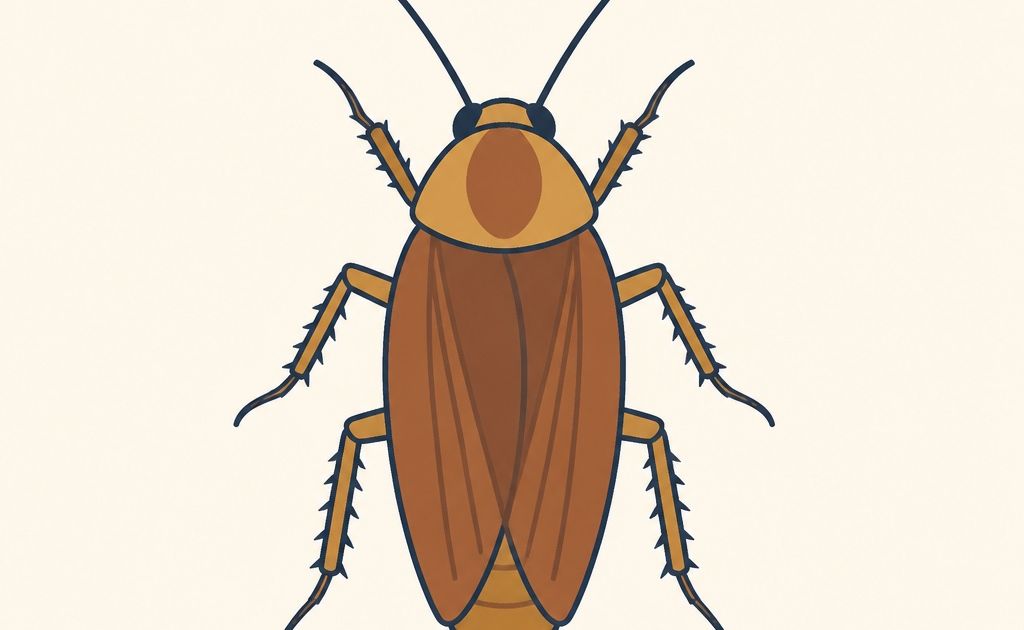
It’s 1 to 1.5 cm long, honey-brown, with two dark parallel stripes on the shield behind the head. That’s the mark you can read from a step away.
It doesn’t come in from outside every day. It arrives once, in a carton, a used appliance, or a suitcase back from a trip, then breeds in the kitchen on its own. Today’s infestation could have started with one individual last year.
The female carries her egg capsule on her abdomen until it’s nearly ready to hatch. One capsule holds 30 to 40 eggs, and she produces 4 to 8 in her lifetime. Spray while she’s carrying one and the insecticide kills her but rarely the eggs. They hatch later, while you think it’s over.
Egg to adult takes 2 to 3 months in a warm kitchen, so a small infestation left alone becomes large in a season.
Its favorite harborage isn’t under the sink, where most people look. It sits behind the fridge motor, inside the microwave housing, behind the stove, in the washing machine cavity. Warm, humid and dark, always.
The American cockroach: the big one that comes up the drain
This one is 3 to 4 cm, dark reddish brown, with a pale yellow rim around the shield. The size alone settles it.
And it usually doesn’t breed indoors. It lives in the sewer network, the basement, the light wells and the courtyard, and enters through a floor trap whose water evaporated, a broken drain cover, or an unsealed pipe. One big roach in the bathroom every few days is a visitor, not a colony.
It can spread its wings and glide a short distance downward, which is why many believe in a third species, the flying cockroach. There isn’t one.
The consequence: if the source is the bathroom drain and you sprayed the kitchen, you treated the wrong room. The roach keeps using the pipe, and you keep buying cans.
Identifying yours in thirty seconds
Small roaches in the kitchen, some out by day? German, and not a small infestation. One large roach at night every few days, no small ones? American, and the source is outside your apartment.
Both? Common in older buildings, and it needs two protocols at once: bait in the kitchen, separate treatment for drains.
| Trait | German cockroach | American cockroach |
|---|---|---|
| Size | 1 to 1.5 cm | 3 to 4 cm |
| Color | light honey brown | dark reddish brown |
| Field mark | two dark stripes behind the head | pale yellow rim on the shield |
| Where it breeds | inside the kitchen itself | drains and the basement |
| How it arrived | a carton or a used appliance | a drain or a dried-out trap |
| Does it fly? | in practice, no | glides through the air |
| When you see it | at night, and by day if the nest is crowded | at night only |
| What you find | egg capsules and black specks | one large roach in the bathroom |
| Correct treatment | gel bait inside the cabinets | drain and pipe treatment |
From the field: The first place we look for German cockroaches is behind the fridge motor. Skip it and they’re back in about two weeks. We pull the fridge out before opening the tool bag.
Why the cockroach spray you buy makes the problem worse
Most aerosols on the shelf are repellent: the roach senses them and avoids the surface. You kill what’s visible and break the colony into deeper, scattered harborage.
Repellent versus non-repellent
Household aerosols are mostly pyrethroid-based. They kill fast on contact, and have a second property nobody reads off the can: the insect detects them and moves away.
Professional non-repellent compounds do the opposite. The roach doesn’t sense them, walks across normally, picks them up on its legs, and carries them into the nest.
Compare the outcomes. Twenty dead roaches on the counter, against a nest that moved from under the sink into the wall cavity. The first feels like progress. The second is harder to reach.
Colony dispersal: the technical name for “they came back worse”
The call arrives in nearly identical wording. “I sprayed, they thinned out for a week, then came back worse.”
One nest split into three smaller ones farther away, and the eggs the females carried were never affected. They hatched in three places instead of one. It looks like more because they’re now where you weren’t looking.
Resistance: the part nobody mentions
Spray the same active ingredient repeatedly and you kill the susceptible individuals and leave the tolerant ones. The survivors breed, and the next generation resists the same product.
A home sprayed 15 times over two years is not the same as a home never sprayed. Treatment there takes longer and needs rotation between active ingredients, because the population has been filtered already. We see that difference apartment to apartment.
Rotation between visits is standard practice, not a luxury, and it’s why our cockroach treatment identifies the species and source before anyone opens a container. The wrong tool in the wrong place doubles the work that follows.
Gel bait: how it kills the nest, and why slow action is the point
Gel bait works because the roach feeds and returns to the nest before it dies. The colony feeds on its droppings and body, so the active ingredient reaches insects that never crossed the dot.
Secondary transfer: reaching dozens of insects from one dot
This species eats its own droppings and its own dead. The behavior that sounds revolting is the door we come in through.
Nymphs, the roaches that haven’t matured, stay in the nest and feed on adult droppings, so the bait reaches them where they sit. A roach feeds, comes home, dies inside, gets eaten in turn, and the cycle runs again. One dot beats a full kitchen spray.
Why slow action is a feature
A bait that kills in five minutes is a failed bait. The roach dies by the dot and nothing reaches the nest. The delay is designed in to give the insect time to get home.
And the limit, plainly: anyone promising a complete result in half an hour is selling a spray. Expect unusual movement and dead insects in the open the first day or two. A real drop in numbers takes days, not minutes.
Where the dot actually goes
Many small dots beat one large dot. A roach doesn’t travel far, so dots sit close to its harborage: inside cabinet joints at the corners, behind the fridge motor, under the sink at the drain pipe, behind the stove, the washing machine cavity.
And never do this: bait a surface that was sprayed earlier. The repellent residue keeps the roach out of the area and the bait sits untouched for a week. It’s the most common mistake in homes treating themselves. Damp, daily-wiped surfaces aren’t bait locations either.
Where over-the-counter baits fail
Some strains of German cockroach avoid baits built on glucose. Silverman and Bieman documented this in a 1993 Journal of Insect Physiology paper. Wada-Katsumata, Silverman and Schal explained it at the level of the taste neurons in Science in 2013. These roaches taste glucose as bitter and move away.
A second thing kills retail baits: the tube sitting in a drawer for 6 months. The gel dries out and stops being attractive. What’s left is glue on a wall.
From the field: A gel bait dot is about the size of half a lentil. People who buy it themselves squeeze out a line like toothpaste, and the roach walks around it without feeding. Quantity isn’t what kills. Placement is.
Why cockroaches appear in Egyptian apartments, and why the kitchen
Cockroaches don’t materialize out of dirt. They come in along a specific route and stay because they found water and a crack. Those routes can be counted on one hand, and every one of them can be closed.
The drain and the dry trap
Every drain has a bend below it holding trapped water. That water is an air seal against anything coming up out of the sewer network.
A bathroom locked up for a month, or a balcony drain unused since last summer, means the water evaporated and the route is open onto the building’s drainage. That’s the number one source of American cockroaches in apartments, and the fix needs no technician. Pour water down the drain weekly.
Neighbors and shared pipes: no individual fix
One building has one drainage system and one electrical system, both running vertically from the ground floor up. German cockroaches move between apartments along them, especially through washing machine openings that stay open around the pipe.
We’ll be blunt. If your neighbors aren’t treated, the most we can do is close the openings on your side and put a residual on the entry points. That cuts the pressure sharply and stops them from establishing inside your apartment, but it doesn’t remove the source. Sealing is covered by the warranty even when the source is the neighbor’s unit. Their apartment isn’t ours to enter.
Sealing entry points and treating drains is a fixed part of our cockroach protocol. Without it, the bait clears the colony inside and a new one comes up the same pipe two months later.
Cardboard: the thing nobody thinks about
Packing cardboard is cellulose, and the corrugation gives it narrow warm channels. Ideal egg-laying habitat for the German cockroach.
An appliance box behind the washing machine for a year can be the nest itself. Break it down and you find capsules inside the corrugation. Moving boxes are the most common way an infestation reaches a new apartment. People move the furniture and the colony with it.
Light wells and leaks: the permanent water sources
Neglected light wells in older buildings become permanent harborage, especially with standing water or construction debris.
Any small leak under the sink is a permanent water source, and a drip matters more to a cockroach than crumbs on the floor. A clean apartment with a dripping pipe infests more easily than a less clean one with sound plumbing. Same for AC condensate on the balcony all summer, and the wet sponge left overnight.
From the field: A new apartment in Fifth Settlement gets infested before anyone moves in, through the drain lines and the AC duct. The owner blames the furniture. The cockroaches were already waiting.
What cockroaches actually do: contamination, and the link to childhood asthma
The danger isn’t a bite. They don’t bite at all. It’s that they walk through the sewer network and then across your dishes, and their droppings and shed skins become a fine dust children breathe.
Mechanical transfer: from the drain to the counter
A cockroach doesn’t inject anything and isn’t a disease vector the way a mosquito is. It picks up microbes on the hairs of its legs and leaves them on the next surface: sewer line, sink pipe, counter, the plate on the shelf, your child’s food. Organisms documented moving this way include Salmonella, E. coli and Staphylococcus, all from the drain environment it came from.
This is a contamination risk, not a confirmed infection. Not every home with cockroaches has a food poisoning case. But the risk is real and reducible.
Allergens and asthma: the genuinely serious part
Proteins in German cockroach droppings and shed skins break down into light particles that stay suspended in apartment air and settle into shelf dust.
This is one of the strongest known asthma triggers in children in dense urban environments. Rosenstreich and colleagues published the reference study in the New England Journal of Medicine in 1997, part of the National Cooperative Inner-City Asthma Study, linking cockroach sensitization and exposure to asthma symptom severity and hospitalization rates in children.
The symptoms parents blame on dust or the AC: a repeated night cough, wheezing, watering eyes and a running nose specifically in the kitchen.
One practical point. Treatment alone does not remove the allergens. If the colony is gone and the droppings and shed skins are still inside the cabinets, the trigger still works. Surfaces and cabinet shelves need a deep clean once the treatment has run its course. The mistakes section covers timing.
Food and surfaces
That distinctive oily kitchen smell isn’t imagined. It’s colony secretion, it gets stronger as numbers grow, and it survives a surface clean.
Open dry food is the first target: flour, sugar, pasta, and the cat food left in the bowl overnight.
A cockroach walking around in daylight isn’t chance. The nest is crowded, and weaker individuals get pushed out to move at a time that isn’t theirs.
Ways to get rid of cockroaches: what works at home, what’s a myth
Of the home remedies that circulate, only two have a real basis. The rest give you a feeling of control with no effect on the nest.
What has a real basis
Boric acid powder. A slow stomach poison: the roach walks through it, grooms itself, ingests it. It works only if the layer is thin enough to see the floor through, since a mound makes the roach walk around it. It fails once wet, which happens fast in a kitchen, and it’s a hazard if children or cats can reach it. Enclosed voids, not open floor.
Sealing cracks and openings. The highest return for the effort here, no chemical and no downside. Silicone where the counter meets the wall, and around the sink drain pipe. Two hours of work saves a full infestation cycle.
An honest note on cleaning: a deep clean kills no cockroaches. It reduces the food available, making the bait the most attractive thing in the kitchen. It raises the success rate rather than replacing treatment.
What works partially, and under conditions
Diatomaceous earth. The sharp particles abrade the waxy layer on the exoskeleton, so the insect loses water and dries out. Real mechanism, but very slow, and it stops completely in humidity. A kitchen is humid, so its use is limited to dry voids like behind electrical panels.
Sticky traps. An excellent diagnostic tool, not a control tool. Put them in 5 spots overnight and by morning you know where the activity is and roughly how large. Anyone hoping to eliminate a colony with traps will buy traps forever.
What does nothing
Aerosol spray: moves the problem rather than ending it.
Unlabeled tablets and pellets sold loose: active ingredient and concentration unknown, and most of the market is repellent anyway.
Vinegar, soap and water: drowns the roach you spray it on, and that’s all. Zero effect on the nest, zero residual.
| Method | Reaches the nest? | Basis | Its limit |
|---|---|---|---|
| Boric acid | partly | slow stomach poison | fails if it gets wet or piled up |
| Diatomaceous earth | no | dries out the exoskeleton | stops working in humidity |
| Sealing cracks | no | closes the entry route | kills nothing already inside |
| Deep cleaning | no | reduces available food | supports treatment, not a substitute |
| Sticky traps | no | mechanical capture | diagnostic tool, not control |
| Aerosol spray | no | contact kill | repellent, scatters the nest |
| Unlabeled tablets | no | unknown | unknown compound and concentration |
| Vinegar and soap | no | none | drowns the one in front of you |
| Professional gel bait | yes | secondary transfer inside the nest | disabled if the surface was sprayed |
| Drain treatment | yes | closes the American’s source | needs repeating if neighbors are infested |
Is there a smell that actually repels cockroaches?
Some smells keep a cockroach off a treated surface briefly, and none kills a colony or stops it breeding. Repelling isn’t in your interest anyway: it spreads the nest across more locations.
What has a temporary repellent effect
Concentrated peppermint oil. A noticeable repellent effect on the treated surface. The duration is short and the oil evaporates. On top of that, the concentration people use at home is far weaker than the one that produces the effect. The roach leaves the counter for the cabinet.
Ammonia and bleach. The smell pushes the insect away temporarily and the surface looks clean, but the harm to the person cleaning an enclosed bathroom outweighs the harm to the roach. Mixing the two is a real respiratory hazard.
What has no basis at all
Bay leaves are the most-shared advice on Facebook here, with no demonstrated effect. A dry leaf in a cabinet corner does nothing. Same category: cucumber peel, coffee grounds, lemon peel, onion and garlic, naphthalene and camphor tablets. Naphthalene affects people in a closed room more than insects.
Many of these started as recipes for other insects, like keeping moths out of a wardrobe, and got transferred to cockroaches by mistake.
Why repelling is a bad outcome
Your goal isn’t for the roach to stay off the counter. It’s for it to feed and go back to the nest.
Anything repellent, a smell or an aerosol or a harsh cleaner, works against the bait. When we place bait and learn the cabinet was wiped with a strong detergent the next day, we know that dot will sit untouched.
The line worth keeping: a strong smell moves the problem from one place to another. Bait ends it where it is.
| Smell | The claim | What actually happens | Verdict |
|---|---|---|---|
| Peppermint oil | kills cockroaches | keeps them off the surface for a while | temporary effect |
| Bay leaves | drives them out of the cabinet | a dry leaf has no effect | no effect |
| Cucumber peel | makes them flee | no basis | no effect |
| Coffee grounds | a natural trap | organic residue attracts, doesn’t repel | the opposite of what you want |
| Lemon peel | a smell they hate | very weak and very short | no effect |
| Ammonia and bleach | wipes them out | repels briefly, harms your lungs | harmful to the user |
| Naphthalene and camphor | keeps them from entering | doubtful effect, choking smell | harmful to the user |
7 mistakes that bring cockroaches back after treatment
Most “they’re back” calls are caused by something that happened after the treatment, not the treatment. These are the seven we see every week, most common first.
1. Spraying over the bait
You spot a roach two days after treatment and spray the kitchen to help. The repellent residue disables the bait completely, because the roach won’t come near. Then you conclude the bait failed.
2. Wiping bait dots away while cleaning
The dots sit inside cabinet joints and other places that aren’t obvious, and the first deep clean removes half by accident. Get a map from the technician before he leaves, and photograph it if the apartment is large.
3. Deep cleaning with harsh detergents right after the treatment
Deep cleaning matters for allergens, as above. But the timing is after the treatment has run its course, not the next day. Cleaning early with a strong detergent strips the residual off entry points and cracks.
4. Ignoring the drain nobody uses
The service bathroom nobody enters, or the balcony drain. The route stays open onto the sewer network whatever gets done in the kitchen, and the American cockroach uses it regularly.
5. The cardboard comes back
Two weeks after treatment a new appliance arrives and the box gets stacked behind the washing machine. The environment we removed came back by your own hand.
6. The leak nobody fixed
A dripping pipe under the sink means a permanent water source. The treatment then works against ideal conditions for the insect, so results are weaker and slower. A plumber for half an hour changes the outcome more than any compound.
7. Judging the result too early
Judging a bait-based treatment after 48 hours is a decision on incomplete information. The right first-week indicator is the direction of the count, not total disappearance.
From the field: The most common call at day 10: for two days we’ve been seeing dead cockroaches in the middle of the kitchen. That’s exactly what should happen. A nymph leaving the nest in poor condition dies in the open. The next week the count drops.
The first question we ask on the phone is whether the place has been sprayed before. The answer changes the cockroach treatment plan and how long results take, because a sprayed surface has to be dealt with first.
Getting rid of cockroaches for good: prevention after the treatment
The phrase “for good” holds under one condition: the routes they came in through get closed. Treatment removes the colony you have. Prevention stops the next one.
Water before food
A cockroach lives for weeks without food and only days without water. That inverts your priorities.
Fix any drip, however small, and find where the AC condensate goes. A unit dripping onto the balcony is a permanent water source all summer. It’s the cheapest item on the list.
Sealing: what gets closed with what
Silicone for the counter-to-wall joint, the sink joint, and narrow gaps between cabinets. Foam or cement filler for wide openings around the washing machine and drain pipes. Fine wire mesh on the extractor and ventilation outlets, so they work without being an entrance. A strip under the apartment and kitchen doors if paper fits through.
Weekly habits
- A glass of water weekly into every unused drain, to keep the air seal.
- No cardboard behind appliances, under the sink, or on the balcony.
- Dry food in sealed jars, not bags closed with a clip.
- A lidded bin, emptied before bed rather than in the morning.
- The sink dried at night, no sponge left wet in it.
- The cat’s bowl picked up at night, not left full.
- Under the stove and fridge wiped monthly, not just at holidays.
- A monthly look behind the fridge motor with a phone flashlight. One minute saves a treatment.
The honest limit
In a building with a general infestation, prevention reduces the pressure and may delay the return a full year. But no prevention list substitutes for treating the apartment next door. If your neighbor has an active colony and the pipes are shared, you’re lowering the odds, not eliminating them. You deserve to know that.
When you need a pest control company, and what the visit involves
Four signs say the infestation has passed the point a home fix can finish. If one applies, the bait you buy yourself will lower the count and nothing more.
The four signs
- Cockroaches out during the day, meaning a large infestation, not an early one.
- Brown egg capsules the size of a rice grain in cabinet corners or on shelves.
- Small black specks like ground pepper on shelves and in corners.
- A distinctive oily smell in the kitchen that survives cleaning.
Can’t I just buy bait and place it myself?
The tube isn’t the difference. It’s identifying your species correctly at the start and getting dots into places with real activity rather than obvious ones. Drains and entry points then have to be closed the same day, or a new colony reaches you through the same pipe two months later.
Doing it yourself brings the count down for two or three weeks, then it drifts back. There’s a second difference that has nothing to do with the product. If the infestation returns in two months, who pays? A return inside our warranty period is on our account, written on a dated certificate rather than agreed verbally.
How the visit runs
We identify the species and source first, kitchen or drainage, before anyone opens a container. Gel bait then goes into precise dots inside the cabinets and behind the appliances, the fridge motor first. Drains and pipe entries get a different compound, since the objective differs. At the end we seal the cracks and entry points we found.
The whole job is done in a single visit lasting an hour and a half. Any other pest present is treated in that visit at no extra charge, so ants or fleas alongside the cockroaches are handled on the same call.
The pesticides are registered with the Egyptian Ministry of Health and odorless, and nobody has to leave the flat during the visit or after it. The warranty is 3 years, on a dated certificate, signed and stamped, handed over with the invoice.
Warranty limits get stated on the phone, not buried in small print. We don’t treat the neighbor’s own apartment. An infestation shown to have entered after the visit with used furniture or a suitcase counts as a new case, and the burden of showing that is ours, not yours. If another company treats the unit during the period, the warranty stops. With fleas or ticks it’s tied to the animal being treated by a vet in parallel, since the cycle runs from the animal.
Average arrival is 90 minutes within Greater Cairo, and the company has worked in Egypt since 1996.
Frequently asked questions
What’s the best cockroach insecticide?
There’s no best insecticide, only a correct tool per species. The German cockroach needs a non-repellent gel bait that reaches the nest; the American needs drain and pipe treatment with a different compound. The active ingredient matters more than the trade name, since the same one sells under ten names. The question worth asking any company is whether the product is registered with the Ministry of Health at all.
How long until the cockroaches are gone?
You’ll see an effect in the first 24 to 48 hours: unusual movement and dead insects in the open, then a noticeable drop during the first week. The full timeline depends on the size of the infestation and whether the place was sprayed before. A large one with overlapping generations takes longer, which is normal, because the capsules hatch in batches.
Why am I seeing more cockroaches after the treatment?
Our most frequent question, and it’s a positive indicator. The bait is reaching the nest, and the nymphs inside come out in poor condition and die in the open instead of somewhere hidden. You’re seeing what was already there. It lasts a few days, then the count drops. A flat count after two weeks is the worrying sign, not a rise in the first.
Is gel bait safe around children and cats?
The dots go inside cabinet joints and behind appliances, out of reach of a child or a cat, and the technician tells you where they are before he leaves. Bait doesn’t send you out of the home the way spraying does. No ventilation period, no waiting. No chemical is absolutely safe. Exposure here is effectively zero, and placement is what achieves that.
Do cockroaches fly?
The large American cockroach spreads its wings and glides a short distance, usually downward from a high point. That isn’t true flight the way a mosquito flies. The small German in practice does not: it has wings and doesn’t use them. There’s no third species called the flying cockroach. That’s the same American from the drain, and it needs drain treatment.
My home is clean and I still have cockroaches. Why?
Cleanliness reduces the food available, but it doesn’t close the route in. The German cockroach arrives inside a carton or a used appliance, then breeds in the cleanest kitchen as long as there’s water and a warm crack. The American comes up a drain whose water dried out, however clean the bathroom. The difference is water, cracks and cardboard.
The short version
The species determines the tool: German means bait in the kitchen, American means treatment in the drains. Spraying splits the nest across more locations; bait reaches it where it sits. If the routes stay open, the problem returns however good the treatment.
Not sure which species you have? Photograph the roach or the egg capsule and send it to us on WhatsApp. We’ll tell you German or American and what to do. Every way to reach us is on the contact page. The quote is written before work starts, and the 3-year warranty comes on a dated certificate, signed and stamped, with the invoice.
Need Cockroaches treated properly?
One visit treats Cockroaches and any other pest in the unit, with a written quote before we start and a dated 3-year warranty.
Read next
Bed Bug Bites: What They Look Like and How They Differ From Mosquitoes
A bed bug bite arrives in a line or a cluster of 3 to 5 on exposed skin. A mosquito bite is single and scattered. The proof is on your mattress seam.
20 min read
Woodworm or Termites? Diagnose Before You Pay for the Wrong Treatment
Round 1 to 3 mm holes with flour-fine dust means woodworm. Mud tubes and gritty dust mean termites. Three tests you can run yourself in two minutes.
17 min read