
Woodworm Treatment
Woodworm or Termites? Diagnose Before You Pay for the Wrong Treatment
The bottom line
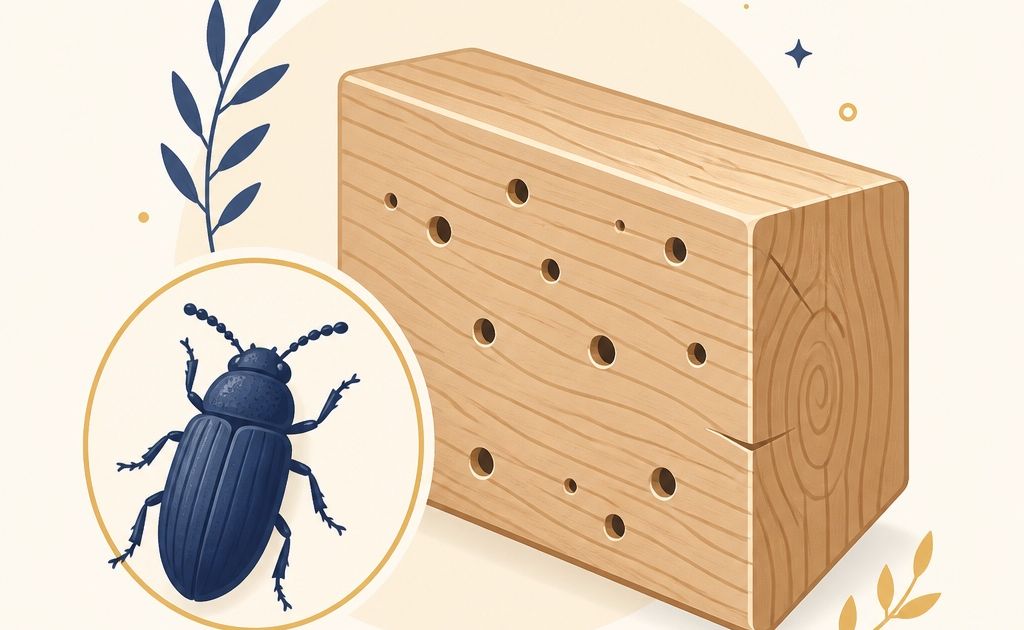
Woodworm leaves round holes 1 to 3 mm across and dust as fine as flour under the piece, while termites leave mud tubes on walls and wood that is hollow inside with an intact surface and no visible holes. The difference is not cosmetic: woodworm is treated by injecting a compound into the tunnels inside the wood, termites need a termite specialist, and a wrong call means paying for a treatment that cannot reach the problem while the damage keeps growing.
Confusing the two is the most common reason a wood treatment fails in Egyptian homes. Someone sees chewed-up wood, says “woodworm,” and stops there. Someone else sees a pale insect, says “termites,” and stops there. Everything after that gets built on a guess. People pay to treat a wardrobe when the problem is in the soil under the building, and others wait on a termite specialist over one piece of furniture that needs injecting. This article is not an introduction to two insects. It is a diagnosis you can run yourself, on the piece in front of you, with signs you can see and three tests that take two minutes.
What is the difference between woodworm and termites in appearance?
Woodworm is a hard-shelled beetle, dark brown and cylindrical; a termite worker is the opposite, soft and pale, with a broad waist where a regular ant is pinched. The clearest difference without a lens is the wings: a termite has four, all the same length, while the beetle keeps its own hidden under a hard case on its back.
Color and body texture
Woodworm beetles run dark brown going on black, hard-shelled, 2 to 7 mm long depending on species. In many, the head stays tucked under a hood-like plate, so from above you see no head at all. Pick one up and it feels like a shell, not a body.
A termite worker is built the other way: white going on pale tan, soft, close to translucent, dying quickly once exposed to air. That isn’t a cosmetic detail. A body like that has to stay inside a mud tube instead of walking in the open, so an insect strolling across a surface in daylight, unbothered, is not a termite worker. Uncover a real one and it heads straight back into its tunnel.
Wings, and why people mix up flying termites with flying ants
Flying termites leave the colony in mating season to start new ones. Four wings, all the same length, longer than the body, dropping off easily after landing. A pile of shed wings on balcony tiles or around a light fixture means a colony is branching out nearby.
A flying ant looks different: front wings longer than back wings, waist visibly pinched. That’s the confusion worth clearing up, because flying ants get taken for termites constantly. Woodworm never enters this picture: the hard case on its back covers its wings, and you will never find shed wings beside an infested piece.
Antennae, the difference nobody mentions
The most precise sign there is, if you can get close enough. Termite antennae look like a string of beads: small round segments in a row, straight, no bend. A regular ant’s are elbowed. Woodworm antennae are short, often ending in three wider segments.
From the field: Honestly, you probably won’t see the insect at all. Woodworm spends most of its life as a larva inside the wood, and termite workers avoid light. If you’re waiting to see one before you decide, you’ll be waiting. The verdict comes from what it leaves behind.
Reading the damage: how do I tell woodworm from termites without seeing the insect?
The evidence is more reliable than the insect, because it stays put after the insect has gone. Round holes with clean edges plus dust as fine as flour means woodworm. Mud tubes on a wall, or wood hollow inside while the surface looks untouched, plus dust with grit like sand, means termites.
The woodworm fingerprint
The holes are round, 1 to 3 mm across, edges clean, as if somebody pushed a needle through. The regular circular shape is the giveaway. Underneath sits very fine wood dust that powders away between your fingers with no grit in it.
Here’s the part people get backwards. The hole isn’t where the insect went in. It’s where it came out. The larva spent years inside eating and tunneling, then chewed its way out and left that hole behind. By the time the first one appears, what you can see is a fraction of what is there.
Where they turn up: the back panel of a wardrobe, the underside of shelves, the inside of drawers, under stair treads, and any unpainted wood in a dark, damp spot.
The termite fingerprint
Mud tubes have no equivalent anywhere in the woodworm world. Tubes of packed soil, roughly the width of a pencil, running along a wall or up a pipe, with the workers traveling inside them in the dark and the damp. See one and stop diagnosing. That settles it.
The second sign is wood hollow inside while the outer skin is intact. Press it with a finger and it gives or crumbles, though the surface looked normal a second earlier. The dust has gritty particles like sand, sometimes closer to clay, and there are no regular round holes. If you’re looking at those, push termites down your list.
Is the infestation active now or is this old damage?
That’s a separate question, and old damage from an infestation that ended years ago doesn’t deserve the same response.
Dust color gives a first indication. Fresh dust is light, the color of the wood’s interior; dust that has sat for months goes darker. Hole edges say something too: a new one is sharp and light, an old one has faded into the surface around it. Both of those lean. Neither decides. The tests below do.
One small thing matters: don’t vacuum the dust before somebody has seen it. The natural reaction to debris is to clean it up and mention it afterward, and that dust is your only evidence of activity. Its color and texture say things the hole doesn’t. Photograph it, then clean. Watch the air currents too. Under an air conditioning vent or a ceiling fan the dust scatters and lands a hand’s width off, reading as less than it is.
Diagnostic table: woodworm vs. termites on 8 points
Work down this table and see which column your situation matches on most rows. Three matches or more in one column is enough to lean on.
| Sign | Woodworm | Termites |
|---|---|---|
| Holes | Round, 1 to 3 mm, clean edges | No visible holes |
| Dust | Fine, like flour | Gritty, like sand |
| Mud tubes | None | Yes, on walls and pipes |
| Surface condition | Perforated and obvious | Intact outside, hollow inside |
| Body | Hard, cylindrical, dark brown | Soft, pale, broad waist |
| Wings | Hidden under a hard case | 4 equal wings that shed and pile up |
| Where it hits | Furniture, doors, parquet | Upward from the floor and walls |
| Treatment | Injection into the tunnels, then surface protection | Soil injection and barriers, a different specialty |
How to read the result
Only one row decides on its own. Mud tubes mean termites whatever the rest of the table says, because no woodworm builds anything like them.
Everything else, you add up. Two matches, or a result split across the columns, means a photo will beat a description. Shoot the holes close up, and collect the dust on a white tissue so the grain shows. Send both over WhatsApp and we’ll tell you what we see.
There’s a third possibility most people never consider: both in the same home. It isn’t common, but it happens, mostly on ground floors and in villas where wood touches an exterior wall or the floor slab. The sign is evidence that separates by location: round holes on a piece in the middle of a room, a mud tube on a wall or door frame elsewhere. The question stops being “what is this” and becomes “what is where,” and each half goes to a different specialist.
Important note: If your result is termites, we don’t treat termites as a standalone service. That’s a different job built on soil injection and chemical barriers around the building, and it needs a termite specialist. The difference is here so you can diagnose your case, not so we can sell you something we don’t do.
If the result is woodworm, the woodworm treatment protocol built on injection is laid out step by step.
How do I check the wood myself in two minutes?
Three tests, and the whole equipment list is a sheet of white paper and a small screwdriver. None of it replaces a professional inspection, but together they tell you whether the problem is real and whether it’s still running.
The paper test: active or old?
Sweep away all the dust under the piece, put a sheet of white paper directly underneath, and leave it 48 hours with nobody moving or cleaning it. New dust after two days means the infestation is active today. Paper still clean after two weeks says the damage is old.
The gap between the two durations is deliberate. A positive comes fast, because dust falls with any activity. A negative needs patience, because adult beetles emerge on no fixed schedule.
One condition ruins the test: the piece has to stay still. Shaking it knocks loose old dust from the tunnels and hands you a false positive that has you treating a piece that doesn’t need it.
The sound test: hollow or solid?
Knock along the piece with a knuckle, a hand’s width at a time, top to bottom. Sound wood gives back a dense, flat note. Wood that’s been eaten out inside answers hollow, close to a drum.
Your ear judges by comparison, so knock against a section of the same piece you’re sure is sound: species and thickness change the note on their own. The result separates the two possibilities too. A wide hollow zone with an intact surface and no holes leans toward termites; a hollow zone around a cluster of round holes toward woodworm.
The pressure test: still holding or not?
Press the tip of a small screwdriver into the section you suspect. Reasonable pressure, not a deliberate attempt to punch through. If it sinks in easily or the wood crumbles under it, the damage has reached the structure.
Where you run this matters more than the test itself. Do it on the hidden parts: the back of the wardrobe, the underside of a leg, the inside face of a drawer. Those are usually unpainted, and that is where infestation starts.
| Test | How to run it | Result and what it means |
|---|---|---|
| Paper | White sheet under the piece for 48 hours | New dust = active now |
| Sound | Knock with a knuckle, compare to a sound section | Hollow sound = internal tunneling |
| Pressure | Small screwdriver on a hidden part | Crumbles easily = structural damage |
From the field: The most commonly skipped spot in an inspection is the back of the wardrobe and the inside face of the drawers. The wood there is usually neither painted nor varnished, and woodworm prefers it to a finished face. Check the front only and call the wardrobe clean, and you’ve inspected the one part woodworm doesn’t start from.
Got a result and want it confirmed? Send a close-up of the holes and a shot of the dust on a white tissue over WhatsApp, and we’ll give you our reading straight.
The types of woodworm that attack furniture in Egypt
Three groups show up in Egyptian homes: the common furniture beetle, powderpost beetles that go after beech and oak, and whitewood borers in ceilings, partitions, and parquet. Hole size, dust texture, and the wood affected point you at the group in front of you. The treatment is the same for all three; only the technician’s focus changes.
Those three are a working classification we use on the job, not scientific species names. Pinning down a Latin name is laboratory work, and you don’t need it to act correctly.
The common furniture beetle
Its holes run 1 to 2 mm, and its dust is fine with tiny oval pellets you can feel if you rub it in your palm. It prefers older wood and higher humidity, so we find it in old lounge sets, wooden bed frames, and ground-floor doors. Its life cycle takes years, so an infestation runs quietly for a long stretch before anybody notices.
Powderpost beetles, the beech, oak, and imported furniture problem
The holes are smaller, and the dust is extremely fine, pouring out like flour when you move the piece. This group prefers hardwoods with starch in the outer layer, and what reaches us in Egyptian homes is mostly beech and oak, the two most-used furniture woods here.
It also arrives by a route most people don’t picture: inside the furniture on delivery day, not flying in through a window. The source may be outside your home entirely.
Whitewood borers in ceilings, partitions, and parquet
We group these by target rather than appearance: the cheap whitewood in suspended ceilings, room dividers, and under parquet boards. The tell is a hollow sound over a wide area instead of one patch, and the damage turns structural early because those sections are thin to begin with.
| Group | Preferred wood | Hole size | Dust |
|---|---|---|---|
| Common furniture beetle | Old, damp wood | 1 to 2 mm | Fine, with tiny pellets |
| Powderpost beetles | Beech, oak, imported furniture | Under 2 mm | Pours out like flour |
| Whitewood borers | Ceilings, partitions, parquet | Varies | Fine, with a wide hollow sound |
From the field: Most of the new-furniture infestations that reach us did not enter the house from outside. They came in inside the piece, from the warehouse or the carpentry workshop. That’s why we always ask when the piece arrived. Holes in the first year after buying mean the source is probably outside your home, and the piece next to it is at risk now.
One thing ties all three groups together: not one of them builds mud tubes.
Why doesn’t spraying work on woodworm?
Surface spraying doesn’t work because the thing eating the wood is the larva, and it lives in a sealed tunnel centimeters down that it barely ever leaves. The insecticide sits on the surface and dries there while the larva underneath keeps working for years.
The life cycle is the reason
The egg gets laid in a crack or an open pore. It hatches, the larva bores straight inward, and stays there for years eating wood and widening its tunnel. Grown, it pupates near the surface, then emerges as an adult beetle.
What that means in practice: anything applied from above meets one stage out of four, the adult that happened to be outside when the spray went down. The egg in the crack, the larva in the tunnel, and the pupa under the surface are never in its path.
Why the can from the hardware store isn’t the answer
Compounds sold as general-purpose sprays are built to work on a surface, not to penetrate wood fiber. They kill whichever adult happened to emerge around the time of spraying. Nothing inside the wood is touched. The pattern repeats constantly: new holes stop for two or three months, then fresh dust shows up in the same spot.
It isn’t true that spraying is useless. It has a real role as a protective layer after injection, to stop a new female laying eggs there. On its own, though, it isn’t a treatment. It’s the second step, not the first.
And why this matters even more with termites
If the case is termites, it’s worse. Termite treatment targets the soil and the route from the ground into the building, not the wood you’re looking at. Spraying wood there is money gone entirely: you’re treating where the victim is instead of the source.
From the field: A case that comes back roughly once a month: a customer sprayed the piece himself six months earlier, the holes genuinely stopped, then came back worse. The spray killed the generation that was outside at that moment; the larvae inside finished their cycle quietly. It cost six months, and the damage grew through all of them.
The whole difference comes down to getting the compound inside the tunnel. That’s what we do in woodworm treatment by injection.
How is woodworm treated by injection?
Injection means the compound is pushed into the holes themselves so it travels the tunnel network the larvae live in, instead of sitting on the surface and drying. A protective surface treatment against reinfestation follows, and the compound keeps working after the technician leaves, which is why the job closes in a single visit of about two hours.
The steps in practice
- Inspection to identify the type of infestation, woodworm or termites, and which sections are actually active.
- Injecting the compound into the holes to reach the internal tunnels.
- A protective surface treatment against reinfestation.
- Treating any other pest present in the property during the same visit, and handing over a dated 3-year written warranty certificate.
Why injection actually makes a difference
The obvious reason is that the compound reaches the internal tunnels instead of stopping at the surface. The more important one is that the tunnels connect, so injecting a scattered set of holes covers a network far wider than you can see. The residual stays in those tunnels, so no second visit is needed.
Antiques and older furniture
These pieces get gentler handling with compounds that don’t change the color of the wood or attack the varnish. That’s agreed before work starts and written into the quote, not promised on the phone.
There’s one situation where treatment alone isn’t enough. If the structure itself is gone, treatment stops the insect but doesn’t bring back eaten wood. The choice is then between carpentry reinforcement and replacement, and we say so up front rather than let you find out afterward.
What gets handed to you
A written quote before any work starts, listing the protocol and every area being treated. All pesticides are registered with the Egyptian Ministry of Health and odorless. And a 3-year warranty certificate, signed and stamped, with the date on it, handed over with the invoice. Its limits are printed on that paper, not mentioned in passing.
From the field: There’s a moment on the job that confirms the injection is going in properly. The technician injects one hole, and seconds later the compound comes back out of another centimeters away. That means the two tunnels connect inside. Pieces where that doesn’t happen get more injection points, spaced closer together.
Mistakes that make woodworm worse
Most of what reaches us in bad shape went through one of five actions that share a single trait: they hide the sign and leave the cause alone. The two most expensive are varnishing over an active infestation and moving the piece to another room.
Varnish or paint over an active infestation
Varnish seals the holes, so you lose your best indicator of activity, and it blocks any compound applied later. The larva inside was never touched, so it will finish its cycle and chew fresh holes through the new varnish. One decision costs you the diagnostic sign and the protective layer, and the carpentry bill comes round again a few months later.
Moving infested furniture to another room or into storage
That relocates the infestation. It doesn’t isolate it. Adult beetles emerge and lay on the nearest exposed wood, and a dark, damp storage room is the best environment you could hand them.
If you need to isolate a piece until it can be treated, move it away from the rest of the wood and keep a sheet of white paper under it that you actually check. Dry and well lit beats a closed store room.
Filling the holes with putty before treatment
The hole is the compound’s way into the tunnel, and putty closes that door. The correct order is diagnosis, then injection, then surface protection, with filling and finishing dead last.
Home remedies: vinegar, kerosene, and sunlight
Vinegar doesn’t penetrate wood fiber; the most it does is clean the surface. Kerosene and gasoline are a genuine fire risk. Their smell stays in fabric for months, and what they reach inside the wood is limited. Sunlight dries a surface, but a balcony in summer won’t deliver heat that kills a larva centimeters deep.
The one exception with real logic behind it is deep freezing, and size rules it out before anything else: the whole piece has to fit in the freezer. Anything bigger than a small shelf is out from the first step.
“I’ll wait a bit and see”
Woodworm has no season that ends on its own. The tunnels widen every month and the larvae grow, and a piece that needed injection last year can need a carpenter next year.
From the field: A case that repeats: the customer varnishes the lounge set because the holes have disappeared from view, and eight months later new holes appear in the varnish itself. It was a cosmetic layer over a working problem. The correct order is always treat first, varnish second.
The thread running through all five is the same. Each is done to make the sign disappear from view, and not one touches what’s inside.
When should I handle it myself and when should I call a company?
If the infestation is on one small piece and the tests came back negative for activity, watching it with a sheet of white paper for two weeks is reasonable. But if there’s fresh dust, or more than one piece, or the affected wood belongs to the building itself like a door or a staircase, this stops being a household job.
Cases you can monitor yourself
One piece, holes that look old, and a paper test that came back clean after two weeks. Or a piece small enough to isolate easily that you wouldn’t mind replacing.
One condition, for monitoring to count as monitoring: write down the date you started, and go back and look on a set date. “I’ll keep an eye on it,” when it really means the whole thing gets forgotten, is postponement under a different name.
Cases that need a technician
- Fresh dust appeared on the paper within 48 hours.
- More than one piece infested in the same place.
- Structural wood: doors, windows, stair treads, parquet, suspended ceilings.
- An expensive or antique piece, because the wrong compound can ruin the color and the varnish.
- An infestation that came back after a previous treatment.
| Situation | Monitor it yourself | Call a technician |
|---|---|---|
| Paper test | Clean after two weeks | New dust within 48 hours |
| Number of pieces | One piece | More than one |
| Type of wood | A standalone piece of furniture | Structural wood or parquet |
| Pressure test | The wood holds | The screwdriver sinks in easily |
If the result is termites, we don’t treat it
We say this plainly so nobody wastes time: Techno German does not treat termites as a standalone service. Our work is in the wood inside the piece; termite work is under and around the building, a different track with different equipment and a company whose main business is that.
This article gives you the diagnosis so you go to the right people the first time, not so you pay twice. If the case is mixed or unclear, we’ll tell you as it is, even when the job isn’t ours.
If you decide to call
We’ve been working in Egyptian homes since 1996. Average arrival inside Greater Cairo is 90 minutes, and the quote is written before any work starts. A single visit treats every pest present in the property at no extra charge, and the warranty is 3 years, dated on a signed and stamped certificate handed over with the invoice.
The woodworm treatment service page covers the protocol, the duration, and the warranty limits, and you can see how to reach us and our hours if you’d rather talk now.
The real cost of postponing woodworm treatment
Postponing doesn’t only make the problem wider. It moves it into another category. The damage starts cosmetic, holes on a visible face, and ends structural when a leg snaps under weight. That is the difference between a piece that gets treated and a piece that gets thrown out.
Damage moves through three stages
Stage one is cosmetic: holes and dust, structure still sound. Treatment here is at its simplest.
Stage two is functional. The drawer sticks and won’t close, the door swells and rubs the frame, the shelf sags under weight.
Stage three is structural. A bed leg breaks. A stair tread gives under a foot, or a parquet board drops. Here treatment stops the insect, but wood that’s been eaten does not come back.
Spread inside the house
When an adult beetle emerges, it looks for the nearest exposed wood to lay on. An infested piece standing next to a sound wardrobe makes that wardrobe a candidate next season. That changes the size of the job, not just its timing: you come back to more pieces.
The costs nobody adds up
Carpentry and restoration after treatment is a separate job on a separate bill, and the further the damage goes, the bigger the carpenter’s share. An antique at stage three loses its value, and no treatment brings it back. The most serious item has nothing to do with money: somebody getting hurt if the affected part is a stair tread or a child’s bed.
Answering “well, let me just wait and see”
The only useful waiting is the paper test. Dust within 48 hours settles that the infestation is active; paper still clean after two weeks makes it likely it has stopped. So the longest wait with any meaning is two weeks with a written date, not a year on memory.
From the field: The piece we most often see at stage three is the old wooden children’s bed, passed from one sibling to the next, with nobody ever looking under the legs. Testing it takes a minute: press a screwdriver into the inside face of all four legs. If it sinks in, that piece isn’t waiting a year.
If you’ve come out of this with a result, the next step is simple. Send a photo of the holes and a photo of the dust over WhatsApp, and say when the piece came into the house and whether the room is damp. Those two details save half the call.
Common questions about woodworm and termites
Is woodworm harmful to people?
Woodworm doesn’t bite and doesn’t transmit disease. All the damage lands on the wood. What occasionally causes a health problem is the dust: breathing it in continuously can irritate the respiratory system, especially when the infestation is in a bedroom and somebody has an allergy or asthma. The second risk is indirect: a piece at structural damage can break under weight.
Do vinegar, kerosene, or putting the piece in the sun work?
No. The larva lives centimeters deep inside the wood, and all three stop at the surface. The one exception with logic behind it is deep freezing: a small piece left in a freezer for two continuous weeks can genuinely be cleared, if it’s wrapped in a sealed bag so moisture doesn’t condense while it thaws. That’s a solution for a toy or a picture frame. Not for a wardrobe.
Does woodworm spread from one piece to another inside the house?
Yes, and it happens while adult beetles are emerging, not evenly across the year. That’s why people find two or three pieces developing holes in the same month and assume it’s a coincidence. The protective distance isn’t large: an infested piece pushed against another wardrobe is in a different situation from the same piece a meter away.
Will the treatment change the color of the wood or affect the varnish?
Older pieces and antiques get a different compound that doesn’t change color or attack the varnish, and that choice goes into the quote before anybody touches the piece. Say on the first call that the piece is delicate or valuable. On the injection points: we use existing holes wherever possible rather than open new ones, and any filling or restoration is done by a carpenter after treatment, not before.
If it turns out to be termites and not woodworm, do you treat that?
No, and that’s a declared limit rather than an exception. Termites are treated from the soil and the surrounding area, with equipment and permits different from furniture work, so it needs a company whose main business is that. If you go looking for one, two questions save time: do you treat from the soil or only spray the wood, and is the warranty on paper and for how long.
How long does the treatment take and what does the warranty cover?
Woodworm closes in a single visit of about two hours, and any other pest in the property is treated in that same visit at no extra charge. The warranty is 3 years, written and dated on a signed and stamped certificate handed over with the invoice, its limits printed clearly on it. Among them: a new infestation shown to have entered after the visit with used furniture isn’t covered, and the burden of showing that is ours, not yours.
Need Woodworm treated properly?
One visit treats Woodworm and any other pest in the unit, with a written quote before we start and a dated 3-year warranty.
Read next
Bed Bug Bites: What They Look Like and How They Differ From Mosquitoes
A bed bug bite arrives in a line or a cluster of 3 to 5 on exposed skin. A mosquito bite is single and scattered. The proof is on your mattress seam.
20 min read
Get Rid of Cockroaches in Egypt: Two Species, Two Treatments
Two cockroach species in Egypt need two different treatments. Why spraying splits the colony, how gel bait reaches the nest, and what home remedies do.
20 min read